
How to Create a Monthly Budget in 2026: The Very First Step Towards Richness
I know you earn enough money, but after a few days, your salary gets credited, and you have nothing left in your hands. Isn’t it? And the problem remains unchanged after hard work and multiple income sources. This isn’t only your problem; many people face it in their early lives. This frightens ordinary middle-class people who depend solely on a monthly salary. They often borrow money from their friends and make many efforts, but all remain in vain. But thankfully, the solution lies within our education, not effort. The proper education about handling money effectively. This is the art of personal finance or budgeting. Effective budgeting not only can help you get out of financial problems, but can also help you create enough savings for the future even with a single source of income. In this article, we will introduce ‘How to Create a Monthly Budget in 2026‘ so that you can set your life towards financial freedom in the upcoming years.
Your financial freedom is the result of your small money efforts, and Budgeting is one of them. This article will definitely help you on this journey in 2026.
Also Read: How to Earn Money from Social Media in 2026
Why Is Monthly Budgeting Important for the Middle Class?How to Create a Monthly Budget in 2026
Imagine you got a free Netflix subscription for 24 hours, and the freedom to watch anything on it. What will be your strategy? Will you roam randomly? Or make a plan to get the maximum benefit from it? I think you will plan your day for a better experience.
The more you plan, the better your experience. Then why not for your money?
Learning effective budgeting skills and strategies puts you ahead of many middle-class people who spend their money recklessly.
Let us compare two corporate employees with the same salary, and one of them has enough financial education, but another have zero.
The educated one makes a monthly budget and tracks his spending by following some rules, while the other one spends his money without any tracking.
Every month, at the end, the educated one saves some money for emergencies, while the other ends with zero in the pocket. You can be both, as per your behaviour with the money. If you follow some budgeting rule, you will be rich soon; otherwise, there will be nothing for you.
Budget Helps You Control Unnecessary Expenses
‘Neglecting a small pimple can damage your skin in the long term’, similarly, small expenses that you ignore can be dangerous for your financial status.
Your small purchases can become a huge burden on your salary, creating unexpected financial problems.
These consequences can be cured by tracking your small and unplanned expenses.
It saves you from Unnecessary Debts
Using too many credit cards or taking many loans can ruin your financial health in the long run. Making a monthly budget can give you clarity about your savings and emergency funds.
It then helps you stay away from unnecessary debts and credit cards.
That’s why a well-planned budget is essential for middle-class people.
Helps in Emergency
Life is full of unexpected consequences, and emergencies never inform you when it comes. On its arrival, all your savings go away in a blink. And you move towards credit cards and loans in a hurry without any calculations.
To avoid this situation, you need a well-planned emergency fund in your monthly budget. Consistently creating an emergency fund can save you from disturbing your finances.
Offers you Financial Control
Tracking your money assures you where your money is going. This provides peace of mind. And helps you taking complicated financial decisions easily.
How to Make an Effective Monthly Budget that Works? Learn from the Upper Class
Calculate Your Monthly Income
First, determine your total monthly income.
This is usually straightforward for salaried employees. Instead of your gross salary, use the amount that is actually credited to your bank account. If you have any additional income from freelancing, a small business, investments, or other sources, include that as well.
List out your Fixed Expenses
Fixed expenses are costs that generally remain the same every month.
Examples:
Shop rent
Loan installment
Insurance premium
School or college fees
Internet bill
Business charges
Regular household payments
List each expense and its monthly amount. For example, if your shop rent is ₹8,000 and you have a loan…
Track Variable Expenses
Variable expenses can change from month to month. Common examples include: Groceries Dining out Fuel Shopping Entertainment Travel Online shopping Personal expenses Special attention should be paid to these expenses because they are often easier to control. Try to record every expense for a month, no matter how small. You might regret it later otherwise.
Differentiate between Needs and Wants
One of the most useful habits in budgeting is understanding the difference between needs and wants. Needs are expenses essential for your basic lifestyle, such as: Food Housing Electricity Transportation Essential healthcare services Essential education expenses Wants are things you enjoy but can live without, such as: Dining at expensive restaurants New gadgets Unnecessary shopping Premium subscriptions Frequent entertainment.
This does not mean you should give up all your desires. Instead, determine how much you can comfortably spend on them after meeting your essential financial obligations.
Step 5: Set a Saving Target
Savings shouldn’t be something you put off for later. Make it a regular habit to set aside a specific amount each month. For instance, if your income is ₹30,000, you could start with a savings target of ₹3,000. As your financial situation improves, you can gradually increase this amount. You can allocate your savings towards different goals: Income tax payments Short-term goals Long-term investments Education Travel Major purchases.
Consistency is the most important thing.
Even a small amount saved regularly can make a significant difference over time.
Create an Emergency Fund:How to Create a Monthly Budget in 2026
An emergency fund is money set aside to cover unexpected expenses. For example, you might suddenly need money for: Medical expenses Job-related changes Essential home repairs Car repairs A family emergency If you do not have emergency savings, you might have to borrow money to cover an unexpected expense. If necessary, start with a small goal. Once you get into the habit, try to gradually save enough to cover a few months’ worth of essential expenses
Include EMI’s in Your Budget
If you have any outstanding loans or credit card dues, include their payments in your monthly budget.
Do not view debt repayments as optional expenses.
After making the required EMI or minimum payments, and when financially feasible, you might consider making extra payments to pay off high-interest debt.
Reducing high-interest debt can improve your financial situation, as you will spend less money on interest over time.
Set Spending Limits
After listing your income and expenses, set spending limits for different categories. For example:
| Category | Budget |
| Housing | ₹8,000 |
| Food & Groceries | ₹5,000 |
| Transportation | ₹3,000 |
| Bills | ₹2,000 |
| Debt Payments | ₹5,000 |
| Savings | ₹4,000 |
| Entertainment | ₹2,000 |
| Personal Expenses | ₹2,000 |
| Emergency/Other | ₹1,000 |
| Total | ₹32,000 |
The 50/30/20 Rule of Effective Budgeting
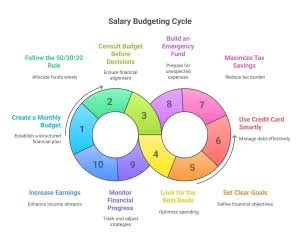
A popular method for budgeting is the 50/30/20 rule. Under this method: 50% of your income is spent on needs. 30% is spent on wants. 20% is set aside for savings and financial goals. If your monthly income is ₹30,000, this would roughly mean: ₹15,000 for needs.
₹9,000 for desires ₹6,000 for savings and goals However, this is just a guideline. If you have significant debt, high rent, or other financial responsibilities, your figures may be very different. The best budget is the one that best suits your circumstances.
Factors Affecting Budget Implementation: Be Aware of These Hidden Foes
Creating an Unrealistic Budget
If you set spending limits that are too low and do not match your lifestyle, you might end up abandoning the budget. Create your first budget based on reality, and refine it gradually.
2. Forgetting Small Expenses
The combined cost of coffee, snacks, delivery charges, subscriptions, and small online purchases can add up to a significant amount. Keep an eye on these expenses.
3. Saving Only What Is Left
If you wait until the end of the month to save, you might find that nothing is left. Consider treating savings as just another one of your fixed monthly expenses.
4. Ignoring Irregular Expenses
Some expenses do not occur every month, yet they can still impact your budget. Examples include: Annual insurance Festivals Repairs Gifts School expenses, and travel. Set aside a small amount each month for these future expenses.
5. Giving Up After One Bad Month
Budgeting is a skill. You won’t get everything right from the very start. If your first month doesn’t go according to plan, learn from it and make adjustments to your next budget.
Summary
Middle-class people often underestimate the power of budgeting. They never create a plan for spending their money. Learning “how to create a monthly budget in 2026“is one of the simplest steps you can take toward better money management.
Budgeting is not dependent on the amount you earn; whatever you earn, you must create a budget. To make this your habit, all you need is consistency, eagerness, and awareness of your small expenses.
Start by calculating your earnings from all income sources. List out all your fixed and variable expenses. Differentiate needs from wants. Set a monthly savings target, and track your spending regularly.
Don’t worry, if your first budget is not perfect, that’s okay.
Think of budgeting as a monthly financial check-up. Each month offers you another opportunity to understand your expenses, correct mistakes, boost your savings, and move closer to your financial goals. Start small, stay consistent, and—instead of wondering where your money went at the end of the month—use your money according to a plan.